“I’m stubbornly committed to the DATA … not majorities … not authorities … not public opinion. DATA.”
Whoo boy Dave, here we go, you might want to find something to hold on to. This and my last will be (I hope) my only long posts from here on out and I apologize for the length ahead of time.
Quote:
David Rohl has pointed out some serious problems with dendrochronology …
Actually, calling a circle a square does not diminish it’s ability to roll. Mr Rohl has not pointed out any serious problems with Dendrochronology your claim notwithstanding. Unfortunately, being YEC, and being thus compelled to create obfuscation strong enough to keep the rubes’ money flowing, he has to use enough information to keep the thinking YEC’s confused. Using real information can be dangerous when you are knowingly using a false argument.
Now Dave, you wrote this:
Quote:
Note the highlighted portion above …
[1]
Quote:
Thus one would be justified in asking if the crucial cross-links which connect up the floating sequences of the Belfast and German chronologies [and by inference, all the other sequences] are based on incorrect wiggle-matches which have resulted from the phenomenon of auto-correlation.
And further questions would be …
[2] Why does Mazar reject the dendro curve? How about the wiggle-match problems? How about auto-correlation? How about inflated t-values? How about the Sweet Track Chronology being withdrawn? The South German sequence abandoned? Why did Kuniholm reject the date with the highest t-value? And so on?
I think a bit of deconstruction is in order here:
By Mazar’s rejection, does Rohl mean Amihai Mazar of The Hebrew University of Jerusalem? The one who coauthored 14C Dates from Tel Rehov: Iron-Age Chronology, Pharaohs, and Hebrew Kings (the article will open with a free subsrcription) with Hendrik J. Bruins and Johannes van der Plicht? (Science 11 April 2003:Vol. 300. no. 5617, pp. 315 – 318)
Because if so, he apparently no longer objects.
Yeesh. Of course that is the Mazar Rohl means.
(Rohl)
Quote:
Bibliography:
Mazar, A. — 1990: Archaeology of the Land of the Bible: 10000-586 BCE (New
York).
…
link
Well, Mazar published that after Rohl wrote his book so we can only note that, as time marches on, another gap gets filled. Mazar’s objection is dealt with and Mazar starts to use the new technology. Strike 1.
Rohl begins by misusing the royal “WE” rather than the correct “I” when he writes:
Quote:
We cannot know for sure why the various dendrochronology calibration curves cause this problem.
Actually, “We” can know this thanks to Ferguson, Stuiver, Yamaguchi, and many many others. Although, if you are any indication, “He” probably can’t. Interesting to note:
Quote:
Unlike the dendrochronologies of the sequoia and bristlecone pine where it was possible to read the rings of individual trees over a period of a few thousand years, the European and recently developed Turkish dendrochronologies have had to be constructed from many shorter lived trees, whose rings have had to be ‘wiggle-matched.’ By cross-matching sequences of narrow and wide growth-rings from different logs the trees can be overlapped — thus extending the chronology backwards through time. This is a straightforward technique and should be relatively easy to implement. However, a number of difficulties have recently come to light.
So, sorry to say this, but it looks like Ferguson isn’t subject to the entire next portion of this editorial, right? Since he had large enough samples with excelent characteristics for his study. Well, never mind. You want to use ferguson 1969 so I guess that’s what we’ll do. Actually, that’s what I did in my draft post I offered to you before you needed to post.
Rohl’s problem is summarized and hinges on this bit here:
Quote:
Another notable weakness in the construction of the European oak chronologies is the use of statistics. In 1991, J. Lasken raised the problem of inflated t-values.15 A t-value is given to a wiggle-match on the basis of a statistical analysis of the correspondence between two wood samples. This statistical assessment is done by computer which assigns high t-values (3 and above) to good wiggle-matches and low t-values (below 3) to those with poor correspondence between the ring patterns. In 1986, D. Yamaguchi recognised that trees tend to auto-correlate — that is they possess the ability to cross-match with each other in several places within the tree-ring sequence. He took a douglas fir log known to date between AD 1482 and 1668 and demonstrated that it could cross-match with other tree-ring sequences to give t-values of around 5 at AD 1504 (for the low end of the ring age), 7 at AD 1647 and 4.5 at AD 1763. Indeed he found 113 significant candidate wiggle-matches throughout the whole of the AD tree-ring sequence.16
Yamaguchi apparently dealt a severe blow to “wiggle matching”. I mean, both Rohl and Batten cited Yamaguchi as scientific proof positive that Dendro ultimately fails because of autocorellation errors, right? Remember that doug-fir log that came up with 3 separate positive matches? That means that both Rohl and Batten must have read the Yamaguchi paper. So I suppose Yamaguchi must have been crushed when he invalidated his own field? Well, just to clear up a little misunderstanding, Yamaguchi didn’t invalidate wiggle matching. He improved it by demontrating the need for fitting autoregressive intergrated moving average models to standardized tree-ring series to remove autocorrelation from them. In fact, I read Yamaguchi and you should too! Here is a bit at the end:
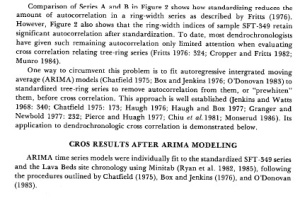
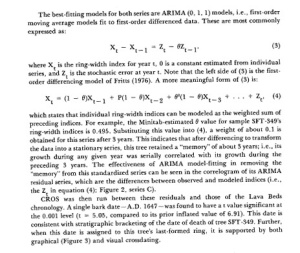
[
Hmmm. Makes you wonder don’t it? Let’s move on:
Quote:
It is therefore interesting to note that a number of the crucial dendrochronology sequences — for example the Garry Bog 2 (GB2) to Southwark sequences which connect the Belfast absolute chronology (i.e. the AD sequence) to the ‘floating’ Belfast long chronology (i.e. the BC sequence), and ultimately used to redate the South German chronology, have t-values of around 4. These t-values are considerably lower than those obtained for some of the historically incorrect dates produced by
Yamaguchi’s experiment. Thus one would be justified in asking if the crucial cross-links which connect up the floating sequences of the Belfast and German chronologies are based on incorrect wiggle-matches which have resulted from the phenomenon of auto-correlation.
Well, fortunately Yamaguchi gave us a way to fix autocorrelation errors and now the field in general addresses them whenever appropriate. A peer reviewer won’t let that problem slip by now that it has been identified. Thank you David Yamaguchi.
Hmmm. Now that I am aware of what Yamaguchi’s contribution was, it would be darned dishonest of me to try to claim autocorrelation problems in more modern peer-reviewed publications that do address the problem now wouldn’t it? Well, thanks for that scanned page Dave, So far all the creationist literature cited demonstrates dishonesty. That is part of my proposal and will certainly be part of my conclusion. Maybe you might want to double-check your sources before you post them.
Actually, I’m glad you don’t. It gives a tiny bit of weight to your objectiveness that you don’t filter them.
Quote:
[3] FERGUSON’S STUDY IS FUNDAMENTAL AND VERY REVEALING
Ferguson’s study analyzed in my last post cannot be dismissed as “an old study.” It seems foundational and is referred to often by later investigators and seems to exemplify the methodology used by all other dendrochronologists, namely …CHRONOLOGY BUILDING PROCEDURE
1) Make an arbitrary assumption that C14 concentration has been more or less constant for at least the past 100,000 years, which requires denial of the Global Flood and its effects on C14 ~4750 years ago
2) Select “good” trees which “date” by C14 to the approximate time frame for which you want to build your chronology.
3) Look for matching patterns which supposedly indicate that the corresponding rings occurred during the same year.
Oh boy. Remember this:
Quote:
I’m stubbornly committed to the DATA … not majorities … not authorities … not public opinion. DATA.
??
Does that statement square with your #1? It seems like the assumption that there was a flood is the only assumption here. See, looking at pure data, one wouldn’t need to have any assumptions. Why do you need to assume that 14C has been constant when we can, with no assumptions, measure 14C levels from dateable objects and look to see what they are? BTW, this has been done.
Quote:
Once this is done, I suppose that various wooden items such a roof beams from ancient sites can be placed in the approximate time frame by C14, then placed more accurately by matching rings in the master sequence.
As far as I can tell, this is the supposed value of dendrochronology “calibraton” of C14.
How can you be so far off and still be able to get a fork to your mouth without putting out an eye? Dendrochronology establishes ages and then is used also to calibrate 14C for 14C’s sake. It is merely one of many independent 14C calibration methods. Dendro does not need 14C but 14C needs dendro. However, since so many disciplines depend on 14C calibrations being accurate, labs that publish 14C calibration data do not rely on any individual method. See Fairbanks.
Quote:
Note that physicist SAWells (PhD in earth sciences from Cambridge) confirmed point (2) above in this Forum in the Dendro Comment thread …
Quote:
SAWells Posted: Thu Jun 14, 2007 5:43 pm
a) Samples are often roughly ordered using C14, simply so that you don’t waste time trying to ring-match a ~10000YO sample with a modern one. This rough ordering is not the final date assigned to the sample.
So?
Quote:
OBVIOUS (TO ME) PROBLEMS
1) the HUGE assumption that there was no Global Flood calls into question ALL C14 dates >~3000 yo. So the “rough ordering” of samples >3000 yo is highly suspect.
2) Even if (1) were not a glaring problem, Rohl’s discussion above is very telling and raises numerous questions which cannot be hand waved away.
Let’s see. Did I already address these? Oh yes, The flood. An unbiased look at the data doesn’t lead the alien observer to even suspect that there was a flood. So, the assumption here is that there was a flood. Unwarranted assumption I mean. And Rohl’s problem’s turned out to be dishonest obfuscations so hand waving won’t be necessary.
Quote:
[4]Do you get the picture?
It seems that if we strip away all the pre-conceptions of uniform C14 and >10,000 year history of civilization, what we have left is some extremely questionable assumptions applied to some not-very-robust data sets to come up with some very shaky conclusions.
Preconceptions. You keep using that word. I do not think it means what you think it means. I don’t think any pre-20th century scientist or non-scientist for that matter had any pre-conceptions about 14Calibration. If we strip away all preconceptions, we would never even suspect that the flood myth existed.
Quote:
Not the way I like doing science.
I know.
Quote:
Now, BWE … please …
I am not interested in later papers at the moment. I am INITIALLY interested understanding MASTER SEQUENCE BUILDING.
Ferguson seems to be a key player in this as basically the “foundation layer” for all that followed.
I should certainly like to see hi-res photos of the 17 samples he used to build that chronology pictured in my last post. [5]Have you seen these samples? [6]Any way to get hi-resolution photos of them? [7]Are the hi-res photos published in some paper somewhere that I can obtain? And how about my questions on the Comment Thread? [7]Can you explain Mean Sensitivity=0.33 and Serial Correlation=0.46? What does this mean?
Thanks. Over to you.
Answers to questions 5, 6, 7.
5.No. Why? I would use databases to check my own samples against because all that work has already been done. You can find important data here.
6.I don’t know. Why? Do you know an expert who needs to examine them? You could call the Laboratory of Tree ring Research at the University of Arizona and I’m sure they could help you out.
Main Office: 105 West Stadium
Tucson, AZ 85721-0058 USA
phone: +1 520 621 1608
fax: +1 520 621 8229.
7. Sensitivity refers to the kind of rings the sample exhibits. The lower the number, the higher the ring width sensitivity, the higher the number, the higher the ring width complacency. Remember complacency? That’s the dishonest ommission that Batten used to try to equivocate dolphis and rutting tigers or whatever it was. I do find it rather amusing that you are asking me questions about the post I haven’t posted yet. .33 is pretty darn sensitive. That’s the reason I posted Ferguson as a reference supporting my argument that Batten was dishonest for equivocating non-equal entities. It’s funny how you managed to pick that nugget out of there, possibly recognizing the potential discomfort but not knowing which end it was coming from. The serial correlation is a first-order (There is no small sense of irony here) equation relating every ring with the previous ring. .46 means that the samples are complete enough to account for missing rings etc. In other words, he is explaining why his samples are among the best possible samples available in the world. A basic primer on ring anomalies can be found here.

The thing that makes it really funny is that you didn’t deal with any of it. So, here it is. The post I warned you about. Which, as I correctly guessed, would counter your objections and answer your questions. There is a strange bit of irony here.
The quotes you chose from Ferguson misrepresented his work.
From your last post:
afdave1 wrote:
What you will find is that the 7104 yr Master Sequence is composed of 17 samples represented in the graph below (from the paper)[omitted].
More details about the samples can be found in Table 2 from this paper, shown below.[omitted]Starting with Ferguson’s abstract, I note that he says …
Quote:
The [7104-year] chronology was extended backward in time by incorporating tree-ring series from living trees up to 4600 years old, as well as from standing snags, fallen trees, large remnants, and eroded fragments.
OK. The obvious question is “How did you know that particular samples should fall in the 4600 – 7104 year old range?”
But Dave, the tables YOU POSTED ABOVE, are examples of HOW HE KNEW! By correlation!
No matter how he arrived at his tentative dates, he arrived at his absolute dates by using ring correlation. Just before the part you quote-mined, he labels 3 statistical procedures he uses to create his master sequence. Note the parts highlighted in Yellow. The first part is methodology and the second is your quote-mine. I underlined some other non-circular shit too but at this point I’m done with Ferguson. He set the bar. Yamaguchi, if you’d bothered to read him, actually refines the process and makes it even more sensitive. I’m sorry to post such a long quote here but the context for your quote-mine is aggregious::
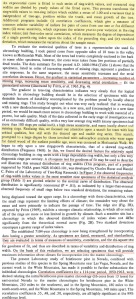
You need to read the paper. Then read Yamaguchi. I did and you should too.
Now, since Ferguson represents the science in it’s infancy in his 1969 paper, and since all subsequent science in the field is refining the techniques, lets just clear up this one last little detail on that:
Quote:
Well after careful reading, I don’t get a clear answer. But there are some clues. There is one clue in the following quote (also from the abstract) …
Quote:
The availability of datable wood in the 9000-year range has been indicated by radiocarbon analysis.
9000-year range? I thought we were going back to 7104 years ago. I’m not sure why he mentions this. BWE? Can you explain? Is he simply referring to later studies which extend the present 7104 year series back another 2000 years? Or is he saying that THESE samples, which are used as the basis for the 7104 year chronology are placed there because of radiocarbon analysis??
In any case, Dr. Batten’s point is well taken, whether this statement refers to THIS chronology, or to a 2000 year extension of this chronology, this is a big deal. Let me highlight this again …The availability of datable wood in the 9000-year range has been indicated by radiocarbon analysis.Wow. There it is. Right there in the abstract.
Exactly what Dr. Batten wrote…Wait a minute! I thought that Dendro was an INDEPENDENT calibration technique for calibrating Radiocarbon Dating. Now you are telling me that we FIRST determine what date range to assign to the wood by RC dating, then we turn around and use this “independent” tree sequence to calibrate RC dates??
Wow. Just wow. So it seems that Dr. Batten is right.
So, no, it seems that Don Batten, CE, was wrong. The dating was done through statistical correlation not 14C dating. The fact that the research was done to establish an independent line of dated material that would be 14C datable is the WHOLE POINT.
Quote:
WOW again.
Now, BWE … I am happy for you to try to show me why this is not really what it looks like it is. But what it LOOKS like is …
1) The Radiocarbon folks were eager to come up with “calibration” for their work
2) They latched on to Ferguson and his new Dendrochronology.
3) They “helped” Ferguson pick samples of the earliest possible age
4) These “early age” samples were determined to be “early age” by radiocarbon dating
5) Ferguson took those samples and matched them up as best he could
6) But as Yamaguchi (1986) showed later, auto-correlation of rings is a major problem, so it appears quite possible that the selected samples could fit MANY date ranges
7) The Radiocarbon people were happy because now they had their “calibration”
8) It seems the radiocarbon people don’t care about Yamaguchi
1. Once again, that was the point.
2. see 1
3. I don’t care if you are stupid but I do care if you use your stupidity for evil. No they didn’t.
4. Wrong. They were picked for appearance of age and used after statistical correlation put them in the master sequence.
5. That’s what the paper was about.
6. And you are using the new, more refined and precise math to prove what exactly? That it only gets more exact?
7. Once again, right. THAT’S THE POINT.
8. Only in your bible-thumped head. Yamaguchi refined the technique! HE MADE IT BETTER.
I’m going to focus on Don Batten, CE, for a moment. His argument rests on equivocating two different species with radically different environmental conditions.
Here’s a quote:
Quote:
“Sensitive” tree growth: * High degree of annual variation
* Wide and narrow rings intermixed through time
* Limiting growth factor (e.g., rainfall) is highly variable year to year
* Especially true for harsh sites (steep/rocky for moisture sensitivity; see figure at left)
* Reasonably sensitive ring growth is good:
o Matching patterns of relatively wide and narrows rings across trees is
easier when ample variation exists”Complacent” tree growth:
* Low degree of annual variation
* Rings are roughly the same for many years consecutively
* limiting growth factor is not variable from year to year
* Especially true for benign sites (flat with deep soil for moisture complacency; see figure at left)
* Complacent ring growth can be difficult to crossdate:
o matching patterns of relatively wide and narrows rings across trees is
harder when not much variation exists
From a very good primer on dendrochronology at this site.. I read it and you should too!
Don Batten, as a plant physiologist, even a religious one, knows this. He tried to equivocate a species with complacent growth with one with sensitive growth knowing full well that this is exactly what dendrochronologists avoid. Lying for Jesus. Despicable. That was why I referenced Ferguson. I had kid gloves on though. I was trying to gently point out that the bristlecone was chosen for specific reasons. But now that you’ve insisted on going this route, I’ll go ahead and go down it. Creationists are lying to their flock to knowingly suppress knowledge. Nothing Batten says ever again in defense of his religion carries any weight because he is a confirmed liar.
Now, you have provided no refutation of my first post which pointed out that the process is not circular because, in terms of 14C calibration, it is cross calibrated with many other phenomena. Fairbanks has that side of it covered. All the data converge on the same point.
My 3 questions:
1. Where do you support the assertion that 14C calibration curves are built on “not-very-robust data sets”?
2. Can you point me to a single creationist science article making negative claims about dendrochronology or 14C dating that does not use dishonest science or rhetorical games intended to obfuscate?
3. How can Dendrochronology and 14C calibration be circular when Fairbanks’ curves use up to 12 independent sources for 14C calibration curves?
Over to you
P.S. The point of asking 3 questions is that you make your point by making a claim and citing evidence then you ask me three questions you think will damage my case. I guess I don’t mind if you ask me 7 or 200 questions but they shouldn’t be ones you need education on. Remember, we can’t delete these posts. Do you know what it is you are hoping to accomplish here? (That isn’t a formal question BTW, you are under no obligation to answer). |




 A-freakin-mazing